

Why Institutional Investors Own Far Less Than You Think
 If you’ve been scrolling through your newsfeed lately, you’ve probably seen the headlines: “Wall Street Is Buying Up All the Homes!” and “Corporate Giants Gobbling Up America’s Housing Stock!”
The headlines make you think that Blackstone, Invitation Homes, and other mega-landlords are on some mission to own every single home in America.
The actual data tells a different story.
There are approximately 86 million single-family homes in the United States. Of those, about 68 million (82.93%) are owner-occupied—meaning families actually live in them. That leaves roughly 14-15.7 million single-family rental properties.
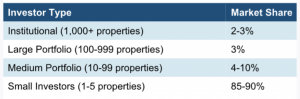
So how are these rental homes distributed among different types of owners? Let’s look at the breakdown:
According to a report from BatchData, 89.6% of all single-family rentals are owned by “mom-and-pop” landlords who own between 1 and 5 properties.
There are 32 institutional investors who collectively own 450,000 single-family homes. That sounds like a lot. But it’s only about 3% of all single-family rental homes nationwide. And remember, this includes all entities owning 100 or more homes, not just the mega-players.
The five largest institutional investors—Progress Residential, Invitation Homes, American Homes 4 Rent, FirstKey Homes, and Blackstone’s portfolio (via Tricon Residential)—own approximately 330,000 to 422,000 homes combined. That represents just 2-2.4% of the entire single-family rental market.
For perspective, consider this: By 2022, those 32 largest institutional investors owned 450,000 homes. Meanwhile, there are about 15.7 million single-family rental properties in the U.S. That means institutional investors own roughly one property for every 35 mom-and-pop rentals.
Here’s where it gets really interesting. In the first quarter of 2025, investors bought 27% of all homes sold. Sounds alarming, right? But here’s what the headlines don’t tell you: institutional investors purchasing more than 1,000 properties made up less than 2.5% of those purchases.
Meanwhile, small investors with fewer than 11 properties represented the vast majority of investor purchases. And just when you thought it was safe to assume all investors are Wall Street firms, here’s another curveball: large institutional investors have been net sellers since at least Q3 2024, selling more homes than they buy.
Many of these mega-landlords are actually shifting their focus to build-to-rent developments rather than buying existing single-family homes.
Most states see institutional investor ownership of less than 1% of their single-family stock. Mega-landlords concentrate in 20 large metropolitan areas, primarily in the Midwest and South where property prices are below national average.
There is a housing affordability crisis. But it’s because we haven’t built enough homes, rates are high, and zoning prevents density in many markets, not because Blackstone and other institutional investors bought all the houses.
The reality is mom-and-pop investors have been and remain the backbone of the rental housing market.